Handwriting and Fine Motor Skills
Hand skills, postural stability, hand strength, bilateral integration, pincer grasp, and prewriting activities
Start Write, Stay Right
Start Write Stay Right is a complete handwriting approach for children, which works on the basis that firm foundations need to be established and good basic skills need to be in place before a child can work on functional and fluent handwriting. The programme works on developing core stability, shoulder strength, basic fine motor skills and early pencil skills (for colouring and other non-literacy activities) before the child can fully engage in the very complex skills of handwriting. A highly positive approach to build confidence and fill gaps which may have been missed in the ordinary classroom process of learning to write. Start Write Stay Right - Integrated Treatment Services.
Hand Skills for Children with Down Syndrome
Children with Down Syndrome are often referred to Occupational Therapy with concerns regarding their hand skills, particularly problems in the development of handwriting. Despite individual differences in learning abilities, there are some physical characteristics of the hands that are specific to the Down Syndrome population, and these have an impact on the development of hand skills.
The hands of people with Down Syndrome tend to be 10-30% shorter than the average population, and the fingers also tend to be relatively short. Bone ossification (hardening) tends to be a slower process, and in some cases, deformities or absences of the digits can occur. Children with Down Syndrome may have difficulty with oppositio,n as the thumb may be set lower on the hand and the fingers tend to be shorter. Pincer grasp (thumb tip to index finger tip) tends to develop late in children with Down Syndrome.
The bones in our hands are arranged in a particular way to enable our hand to form arches along both its length (longitudinal) and the breadth (transverse). These arches provide the curve of your palm that allows you to mould your hand around objects and enable your thumb to oppose (move around in an arc) to touch your fingers. The stability of these arches relies upon the small muscles of the hands (intrinsics). In a child with Down Syndrome, these muscles are often hypotonic (low tone,) and this will affect the child's ability to stabilise the fingers. Tone refers to the amount of resistance a muscle has to passive stretching. Instability of the fingers and decreased strength of the muscles of the thumb may affect the ability of children with Down Syndrome to hold, rotate and translate objects necessary in manipulation.
Function of the hand, however, relies on more than just the anatomical structures mentioned. Good hand skills are dependent on arm movement and stability, vision, sensation, motor planning and organisation to achieve function.
Inability to adapt grip forces to accommodate changes in the friction of object surfaces is related to poor sensory processing. People with Down Syndrome often have thick, dry hands that become rough with increasing age, therefore inhibiting the sensation of light touch in the fingers. The quality of touch discrimination will determine how effectively the child grasps and releases objects.
Children need to be encouraged to hold and explore toys with their hands to increase their understanding of their environment. The hands are also needed to bring toys to the mouth, which aids early and crucial exploration of their world and helps develop oral motor skills. The ability to engage in playful interaction using the hands is an important part of social development and understanding yourself in relation to other people and your environment.
Activities to improve overall muscle tone and shoulder stability, as well as eye-hand coordination, are important to include in play. Eye-hand coordination tasks should start with large objects and progress down to those that require increased precision. Objects that provide varied tactile (touch) input should be included, i.e. objects of different size, shape, texture, weight, and temperature.
As your child moves from nursery into reception, there are many activity ideas you can incorporate into home and school routines that will help maximise your child's hand skills..
Activities to Develop Postural Stability
- "Animal walks" incorporate walking on hands and knees.
- Push-pull games such as "row-row-row your boat".
- Wall push-ups - see if the child can "push the wall down" (with straight arms).
- Pushing heavy objects such as furniture around the room.
- Pushing objects in a toy trolley or a pram.
- Putting books up on a shelf.
- Carrying heavy objects where safe, e.g. shopping bags, library books, etc.
- Working on a vertical surface, e.g. painting at an easel or taping paper to a wall surface for colouring and pasting activities.
- Working on a vertical surface, e.g. painting at an easel or taping paper to a wall surface for colouring and pasting activities.
- Playing with magnets on the fridge.
- Playing with stickers on a large mirror.
- Encourage the child to wipe vertical surfaces - windows or blackboard.
- Hanging/climbing on playground apparatus.
- Jumping games.
Activities to Develop Hand Strength
- Use Play-Doh or plasticine activities; encourage the child to squeeze the "dough" in their hand and roll and pinch it into different shapes.
- Encourage the use of a sponge in the bath or water play, to squeeze.
- Squeeze soft balls, such as juggling balls or rolled-up socks, in the hands.
- Let the child try opening containers with screw on lids.
- Wringing out sponges or cloths.
- Push and pull games such as Lego/Duplo blocks, pop beads, and stickle bricks.
- Scrunching up paper into balls to throw at the target.
- Folding heavy paper or card into different shapes.
- Squeezing glue pens.
- Trigger toys such as water pistols, plant sprayers.
- Wind-up toys that provide resistance.
- Push button toys.
- Playing the keyboard/toy piano/organ.
Activities to Promote Bilateral Integration (Using Both Hands Together)
- Nursery rhymes that have hand actions.
- Ball games.
- Threading.
- Cutting and pasting.
- Cooking/baking tasks - mixing ingredients.
- Simple sewing cards.
- Hole punching.
- Playing musical instruments that require two hands, e.g. drum, tambourine.
- Posting objects into containers/shape sorters.
- Taking lids on/off containers.
- Water play - pouring and filling containers.
- Practising dressing oneself or dolls.
- Finger puppets.
Activities to Develop Pincer Grasp
- Use an eye dropper with coloured water to make pictures.
- Pinch along a length of Play-Doh with thumb and index finger.
- Picking up small objects such as beads, cotton wool, coins, small sweets, raisins - show your child which fingers to use and help them achieve this.
- Threading activities.
- Tearing paper into strips.
- Squeeze open the clothes pegs and place them on the container.
- Peg boards.
- Fuzzy felts.
- Play with pick-up sticks, toothpicks, and straws.
- Bending pipe cleaners.
Prewriting Activities
In order to hold a pencil in a tripod grasp, the child will need to have acquired a pincer grasp as well as the ability to stabilise the thumb and fingers against the pencil whilst the hand moves across the page. This is a very complex task that requires a high level of eye-hand coordination and is affected by many factors such as cognitive abilities, attention, posture, muscle tone and sensory processing. Before a child can learn to write letters, there are several stages in perceiving, copying and forming shapes that need to be mastered. There are activities you can do to help your child with writing/drawing tasks.
To help your child assume a correct pencil grasp, physically position their fingers on the pencil and gently hold them while you draw. Encourage the child to look at how you are holding your pencil and try to copy.
- Use large barrel pencils or markers, as these are easier to hold.
- Use rubber grippers on pencils if your child's fingers often slip.
- Try tracing over lines or shapes with markers or just using fingers. Simultaneously, describe the direction you are moving, e.g. "up, down and around".
- Draw shapes in sand, paint and shaving foam to add strong visual and tactile input using fingers or tools.
- Make stencils out of cardboard and have the child draw around them to make pictures. Stock Blu-tac underneath so they don't slip.
- Draw between lines to help learn concepts of up, down, left, right and diagonals. Start with wide spaces and narrow the channel as pencil control improves.
- Make shapes with Play-Doh. Later, progress on to letters.
- Dot-to-dot activities - use a star to indicate the start point and directionality.
- Work on large surfaces so the whole arm and body ‘feels' the direction of movement required to make a shape.
- Work on a vertical surface to encourage wrist extension and to develop the strength of the arches of the hand.
- When learning a new concept, combine verbal instructions with an actual demonstration and "hands-on" approach to maximise information intake.
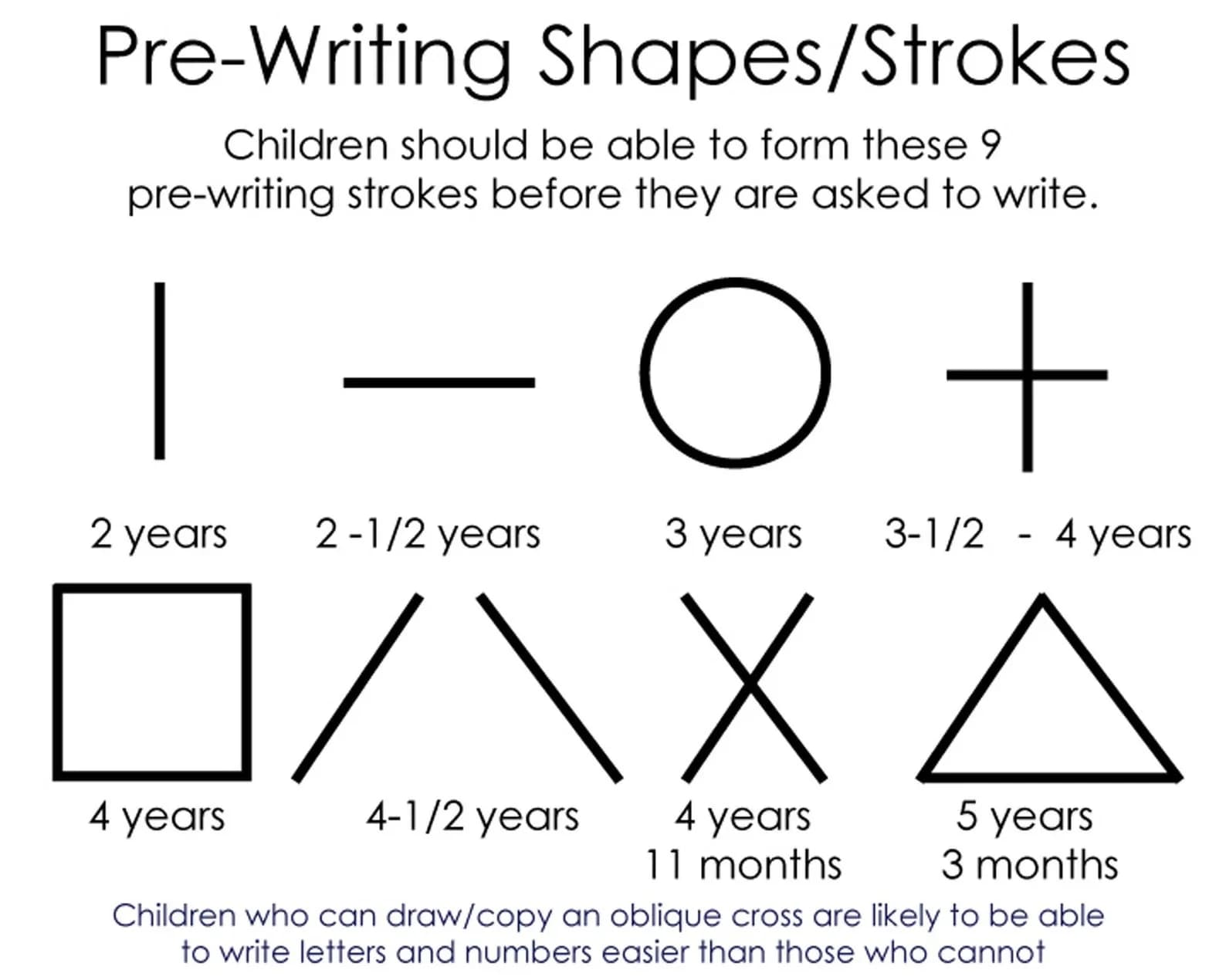
- Before a child can form letters, they need to have mastered some prewriting forms. These are horizontal lines (=), vertical lines (II), circles (O), squares (⬜), crosses ( ), diagonal lines (/ \) and oblique crosses (X). These forms incorporate all the pencil movements required to form letters correctly. Many children find it difficult to learn diagonals, so try using different media to reinforce the direction of movement.
- Try simple mazes which incorporate different actions, angled, diagonal and curved pathways.
- Colour-changing pens are often motivational to get children to trace over shapes or letters and provide a visual reward for correct responses.
Example of An Individual Occupational Therapy Plan for a School-age Child and Recommendations
- Hand strength and endurance - Muscle strength of the hands and fingers increases as children grow and participate in everyday activities. Activities such as climbing, playing with toys or scribbling with crayons all help to develop and strengthen the muscles of the hands and fingers. Hand and finger strength is important as it is required for many everyday activities such as doing up buttons and zips, climbing monkey bars or cutting up a piece of steak at mealtimes. It also helps to develop the endurance to complete activities such as writing a full page. Grip strength refers to whole-hand strength. Pinch strength involves the thumb and index finger (and the middle finger if required). See the link below for activities to promote the strength and endurance for a firmer, more consistent grasp of the pencil. These activities should be completed 3-5 times per week, for 5-10 minutes, to see functional changes occur in the short term.
- Facilitate a more mature pencil grasp - the above strengthening program will help with this but also using smaller, broken crayons, placing small items in an ice cube tray with your ‘pinching' fingers (thumb and forefinger), scrunching tissue paper with fingertips, popping bubble wrap, putting coins in a piggy bank and using connector blocks develops the ability to isolate the thumb and forefinger for a mature pencil grasp.
- Practice pre-writing patterns - this can be done when drawing or playing with crayons. It is important to ensure that all vertical lines start at the top and finish at the bottom, horizontal lines start at the left and finish on the right, and circles start at the top and travel anti-clockwise. These basic patterns will help lay the foundation for the directionality of future writing.
- Easi-loop or Spring-loaded scissors - these help to introduce cutting skills. These particular scissors reduce the demands of opening and closing the scissors repeatedly, which can be challenging if hand strength is lower. Children's scissors.
- Cutting technique - Start by beginning to learn to open and close the scissors to make snips on paper, and using the helper's hand to hold the paper whilst trying to make the snips.
- Seated position - When seated at the table, try to adopt an ideal seated posture to prevent postural fatigue, which can impact attention, focus and stability for fine motor activities (e.g. handwriting). Aim to sit upright, with feet flat on the floor and hips, knees and elbows all at 90 degrees. Shoulders should be relaxed and forearms supported on the table (not hovering in the air).
- Pencil grip - A pencil grip can help support finger placement on the pencil (e.g. reducing thumb wrapping around the pencil) for a more functional pencil grasp, reducing potential pain/fatigue when writing. Pencil grips are available on Amazon.
- Caring cutlery - It is recommended to utilise Caring Cutlery to promote independent use of utensils when eating. This is available to purchase at the Caring Cutlery Range - Complete Care Shop or on Amazon.
Other Useful Resources
- ot4kids - Private online courses for parents and teachers to learn the Sensory and Motor Fundamentals to improve children's pencil control through easy, fun activities. Courses aim to help parents and teachers be clear and confident about where their child needs to start and how to begin developing their pencil control to write. Examples are the 5-part online mini-series informing families about sensory processing, core stability and fine motor skills and treatment activities and the 4-week program where the OT goes through different activities in a progress pathway, with weekly live Q and As to support parents directly and access to a private facebook group for the families on the course to get support, designed for preschoolers and children getting ready for reception.