Sensory Processing and Self-Regulation
Sensory awareness, tactile processing, proprioception, heavy-work and calming activities, concentration, and attention
Activities to Promote Sensory Awareness
- Identifying objects in a bag or pocket without looking.
- Messy play with finger paint, shaving foam, sand, clay, lentils, etc.
- Hide toys in a box of foam or in a box of dried lentils/pasta, and ask the child to try to find them.
- Cooking/baking activities using hands to mix ingredients.
- Make collages using various textures, e.g. wool, pasta, seeds, leaves.
- Play games blindfolded or with eyes closed, e.g. identify or find body parts using hands - nose, ears, eyebrows, fingernails on another person.
- Explore fabric books that have different textured pictures.
- Vibrating pull-string toys and bouncing toys provide strong input to the muscles and joints, as well as the skin.
Improving Concentration and Attention
Environment
- Try to reduce distractions going on around the child by working in a quiet area.
- Choose a quiet room/corner away from windows and doors, with minimal distractions.
- Create a space specifically for working and give it a positive title to this work area, e.g. "Brain Power" table.
- Limit the amount of materials to essential items, such as one book and one pen.
- For younger ones, initially choose toys/activities which naturally interest your child, use bright colours and attractive things.
- Reduce distractions such as pictures on the walls.
- Ensure he/she is sat at a table and chair of suitable height with their feet flat on the floor and elbows resting comfortably on the table top.
- Initially, ask for short periods of attention and gradually increase.
- Create a reward system, e.g. praise ticks on a blackboard, gold stars, public praise.
- Try keeping a logbook to monitor progress.
Giving Instructions
- Always make eye contact.
- Use short and simple phrases for instructions.
- Minimise sequence, e.g. tasks at a time.
- If language is good, ask them to verbally repeat instructions back to you.
- Be flexible and try different approaches if appropriate.
- Having a consistent system of giving instructions helps develop a routine for attention, such as getting whole-class attention in a particular way before giving instructions.
- Encourage the child to actively participate in demonstrations or repeating back instructions, to show their understanding.
Daily Schedule
- Write on a board clearly and simply - Refer to the board as you move from activity to activity.
- Older children - Encourage them to keep their own diary.
Classroom Organisation
- Keep class materials always in the same place - clearly labelled.
- Try to keep the classroom clutter-free, e.g. store materials in a cupboard, etc.
- Keep the blackboard clutter-free.
Desk Organisation
- Provide written instructions.
- Prepare worksheets.
- Emphasise direct attention to important visual aspects of the task, e.g. underlining, highlighting, star beginning and end.
- Use "fill the gaps" answers rather than requiring the child to complete a setting-out/lengthy writing process.
Difficulty Starting Activity
- Give a signal to begin working.
- Present work in small amounts.
- Explain the purpose of the work.
- Provide immediate feedback and encouragement.
- Use a timer and ask the child to say how long the work will take.
Difficulty Staying on Task
- Allow the child to continue with an easier part of the task until you can help.
- Tell the child in advance where you expect difficulties.
- Develop a system of mini-breaks when tension gets too much.
- You may consider 2 places of work for an individual child so they can get up and move around.
- It may be helpful to allow the child to work in different positions - seated, standing, or on the floor.
- Use frequent reinforcement.
- Encourage eye contact.
Difficulty Staying Seated
- Have clear expectations of "good sitting". Use a photo to reinforce the practice.
- Reward good sitting.
- Use a carpet square or spot to keep a place at "carpet time".
- Remove distractions. Position in class where least likely to be passed by others.
- Have the equipment needed to hand and reduce the need to wander.
- Organise and label the room so that things are easy to find.
Needing a Lot of Attention
- Assign a buddy/peer for support.
- Ensure the child has all the requirements for the task.
Working Independently
- Provide activities that are appropriate to the individual child's development level.
- Be certain the child can foresee and end of the task.
- Give brief, precise directions.
- Give frequent reinforcement, and praise the child in front of peers for concentrating.
- Alternate short independent tasks with tasks on which you assist.
- Gradually require more independent work before giving help.
Difficulty Following Directions
- Give short, clear, specific directions.
- Repeat directions and have the child repeat them back to you.
- Use written directions and plans.
- Use a buddy who can help with instructions.
- Position the child in class close to your teaching area.
If the Student Fidgets
- Allow the child to hold a small Koosh ball or a rubber ball.
- Redirect the child to a more constructive task, hand the child an object or book.
- Ignore it.
If the Student Daydreams
- When given a worksheet, suggest the child use a coloured pencil or marker to underline or emphasise directions.
- Place the child nearer to you.
- Reduce activities that require sustained attention. Allow the child structured opportunities to get up and move by collecting materials, putting away items, handing out, etc.
- Use of an egg timer to focus attention on the task.
If the Student Calls Out
- Reward listening.
- Reward the child immediately when you observe them waiting to respond.
- Use the classroom rule cue card to remind the child not to call out.
- Reward peers who do not call out.
- Give each child 3 squares of paper. During the whole class activity, if anyone calls out, remove a square. Students with all squares at the end are rewarded.
Difficulty Following Classroom Rules
- Display rules clearly and reinforce rules verbally and with pictures.
- Keep rules clear, specific and simple.
- Be consistent with rule implementation and consequences for breaking rules, and give the child their own list of the rules.
- Use classroom contracts with pupils and parents.
Hyperactivity
- Deep firm pressure is often useful to calm down, push on shoulders, roll up in a mat/blanket - make hot dogs!
- Time out space in the classroom, e.g. with soft furniture/bean bag.
- Place a heavy bean bag on the child's thighs whilst sitting at the desk.
- Keep tasks short and allow short rest breaks if tired.
Memory
Memory and attention are interlinked; if you can not attend to a task long enough to absorb and store the information, it will not be remembered and therefore not learned.
- Kim's game - Place several objects on a table, look at the items, then cover them up and ask your child to recall the items remembered. Progress by adding more items.
- Card games - Using an ordinary pack of cards.
- Try using prompts such as a diary, calendar, notebook, and to-do list.
Difficulty Remembering
- Use mnemonics.
- Have the child repeat directions.
- Use songs, poems, rhymes to enhance recall.
- Colour code significant details.
- Give short, clear, specific instructions 1 at a time.
- Use charts/pictures/whiteboard to reinforce the timetable.
- Avoid changing the learning environment and routines frequently.
Visual and Auditory Distractibility
Visual and auditory distractibility refers to the child being overwhelmed with visual and auditory stimuli to the point where it interferes with functional ability. They may respond negatively to unexpected/loud noises or make excessive but repetitive noises to compensate. They may become confused by a visually cluttered environment and be unable to see an object, or they may stare excessively at one item.
Useful classroom strategies:
- Giving additional verbal/visual clues may help the child prepare for the experience.
- Identify which children will be most affected by noises and give them extra reassurance to make them feel safe.
- Consider which children are more likely to find large groups like assemblies difficult. Ensure they are not placed in front of speakers, etc and are near the end of the line.
- Consider the use of very low-volume background music. This helps children to habituate to noise and not orientate to every sound.
- Ensure that only one item at a time is presented to the child, e.g. one crayon rather than a bunch of crayons, and encourage the child to put one item away before receiving another.
- Consider the use of workstations with table surrounds to ‘blinker' the child from other visual stimuli.
- Keep group times short.
- The use of visual timetables helps the child to predict changes.
Tactile Hyposensitivity
Children who do not register tactile (touch) sensations often do not perceive touch accurately and want to get more touch. They, therefore, crave or seek out touch to get more information to their nervous systems from the environment. They can also be slow to react to pain, temperature, etc.
Things to try at home:
- Brush arms, legs, back and face with a flat palm, soft cloth or a soft-bristle brush.
- Play with clay, sand, finger paint, shaving cream and any other new and interesting textures.
- Hide an object in a bin of beans or rice and try and ask the child to try and find it.
- Eat lemons, peppermints and salty, tart and spicy foods to give opportunities to try new textures and flavours.
- Eat fizzy sweets such as sherbet lemons.
- Wear clothes with a variety of textures.
- Eat foods with a variety of textures and temperatures.
- Wear a variety of clothing textures.
- Use an electric toothbrush.
If these activities increase the child's activity level, you may want to switch to some more calming activities, such as:
- Eating foods that require heavy chewing, such as fruit gums.
- Rolling the child up tightly in a blanket or a towel to make a "hot dog".
- Get the child to squeeze their hands together, play with firm toys or with Play-Doh.
- Get the child to press their palms together, press down on a firm surface or against their body.
- Play in an enclosed environment.
- lay between mats/cushions to make a "sandwich".
- Chew chewy sweets such as fruit gums.
Sensory Processing - Proprioception (Body Awareness)
Sensory processing refers to how we process sensory information from our environment and our bodies. We receive information from the following senses: touch (tactile), hearing (auditory), taste (gustatory), smell (olfactory), sight (visual), proprioception, and vestibular. Proprioception is the information we receive from our joints and muscles, telling us in what direction we are moving and how much force we are using. Our vestibular sense is our sense of movement. It tells us what direction we are moving, where we are in space and what speed we are moving at. Adequate sensory processing is the foundation for higher skills such as learning, attention, writing, listening, reading and movement activities.
Some people need a high input of sensation for the brain to register it. We say that these people have a high threshold for sensory input. Some people just need a little bit of sense for the brain to register it. We say that these people have a low threshold for sensory input. Different people will experience different thresholds, and these thresholds will vary across environments and depending on your ability to process at that time, e.g. you may not process sensory input as well if you are tired or upset. Sensory processing difficulties became a concern when they impact functional performance, learning or behaviour.
Proprioceptive System
The proprioceptive system is our sense of body awareness. The proprioceptive system is activated when we move our body (muscles and ligaments) against resistance. This then tells us information about where our body is.
The role of the proprioceptive system is to tell us:
- To tell us where our body is - our sense of body awareness.
- Works with the vestibular (movement) system for good balance and posture, eg being able to sit up straight in your chair.
- To be able to move our body parts without having to look at them, e.g. so we do not have to look at our feet when we are walking or look at our lips when we are talking.
- Enables us to move and coordinate our body movements.
- Enables us to judge force: how hard and how soft to touch something.. For example, it will allow you to know how hard to push the page with your pen, how hard you have to hold an object not to drop it and how hard to tap your friend on the shoulder to get their attention without hitting.
- Has a key role in calming the nervous system, so it is an important sensation for helping calm and regulate arousal levels.
Below is a list of some behaviours you may observe if your child has difficulties with processing their sense of proprioception:
- Will have clumsy and uncoordinated body movements.
- Will walk with heavy footing, stamping around.
- Would like to jump down the stairs rather than walk.
- Will like to crash and bang into things, e.g. will jump on the bed but will like to "crash" rather than jump.
- Will like rough and tumble play.
- Will have poor posture, e.g. will slump in a chair at the table, will lean their head on their hands.
- Will lean against everything! If sitting on the carpet, will lean against other children, and will lean against walls when standing up.
- Will have difficulty judging force, how hard/soft to push/hold things. Some behaviours linked to not being able to judge force include:
- Push down too hard on the page when writing, so will push through the page.
- Not push hard enough on the page, so you cannot read the writing.
- Will hold a pencil too slightly so they have no control over the pencil.
- Will hold a pencil so tightly that their hands hurt when they are writing.
- Will slam doors.
- Will hug too tightly - will squeeze really hard when hugging:
- Will "push" other children over, but not mean it.
- Will have difficulty sitting still in their chair. May wrap their feet around the base of their chair. May constantly be rocking or moving their legs when sitting down. - Prefer to sit on the floor rather than in a chair.
Proprioception is the key sense for calming the nervous system. When children are over-aroused (angry or happy), they will seek proprioceptive input to try and calm themselves down. Some children may bite (others or themselves), pinch or hit their heads/faces.
- Excessive chewing - Will chew everything! Clothes, pens… everything!
- Messy eater - Is not aware where their mouth is when eating, so may miss their mouth with their spoon.
- Chewing - They may not notice when food is falling out of their mouths, or they will chew with a wide mouth.
- May not close their mouths and have difficulty with saliva management.
- May have difficulties settling at night to sleep.
- May have some strange dressing routines and habits.
Children with poor balance (also linked to the vestibular system) will run everywhere rather than walk. This is because it is easier to balance when you are moving fast. Imagine you are on a bike. When the bike is going fast, it is easier to remain upright. As the bike slows down, it is harder to stay balanced.
Proprioception and Modulation - Whole Body Heavy Work Activities
Modulation is our ability to stay in the calm/alert state we need to be able to learn and perform our occupations. This is when we are alert enough to pay attention but calm enough to remain focused. Children with difficulties with proprioceptive processing cannot calm/alert state as they are not getting adequate calming sensory stimuli into their brains.
Proprioceptive (heavy work) activities are always calming.
- Whole body - Actions involving pushing, pulling, lifting, playing, and moving.
- Oral motor - Actions such as chewing, sucking, and blowing.
- Use of hands - For squeezing, pinching, or "fidgeting".
Whole Body Proprioceptive Activities - Calming and Regulating
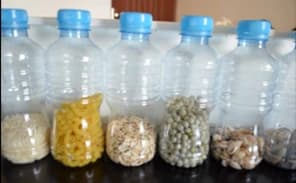
Children who like music will like these homemade shakers. Make them as heavy as your child likes and shake away along to a favourite piece of music while singing their favourite song.
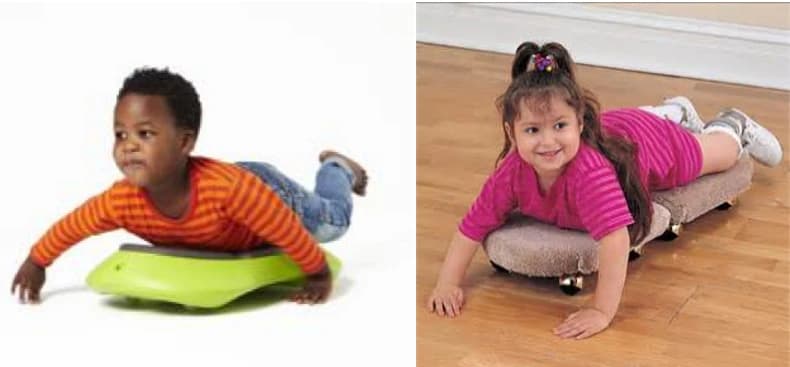
Get the child to play on their tummy, pushing up with their arms. Use a motivating toy or activity to keep the child in this position. This is also a good position to practice drawing in.
Carrying objects
- Shopping bags - Let your child help you carry when shopping when you are out.
- Weighted backpack - Let your child wear a backpack with some weight in it when you are out in public. Make sure the bag is not too heavy so that your child does not adopt a poor posture.
- Stacking or moving chairs/books - At school, let the child help with setting up/clearing away the room. Give them a task to do when they need proprioceptive input, e.g. let them move a box of heavy books for you.
- Filling up a watering can and letting the child water the garden.
Pushing or pulling objects and activities, such as...
- Toy shopping cart or shopping trolley when out shopping (rather than them sitting in the trolley).
- Laundry basket, toy vacuum, mopping or sweeping the floor and see what other household activities your child can help you with.
- Tug of war rope.
- Mop/sweep floor with a mop, broom and dustpan for kids.
- Raking leaves, dirt, etc., using a kids wheelbarrow.
- Pushing/pulling self or others on a jumbo scooter board on their tummy!
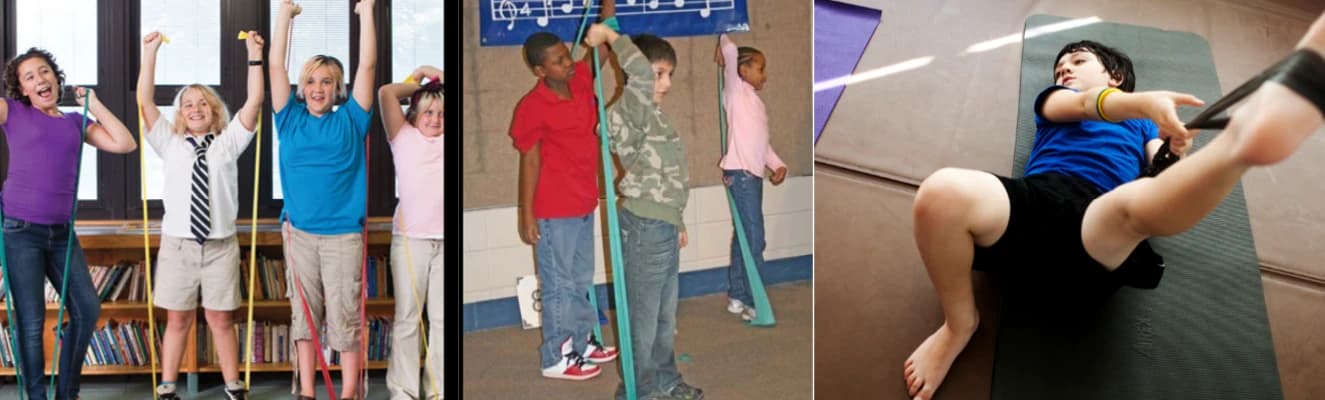
- Thera-Band - Stretch and pull against it with all body parts!
- Jumping and bouncing on/with items, such as on a trampoline, on an old mattress or soft area, into bean bag chairs, on a therapy ball (with adult assistance, of course), on a pogo stick.
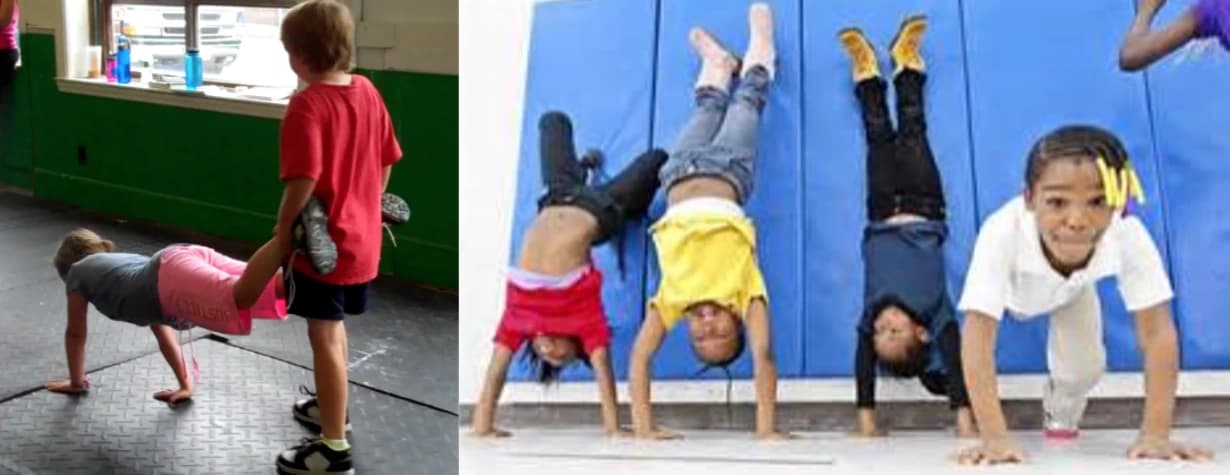
- Wheelbarrow walks, relays and handstands all make your child put weight through her upper limbs.
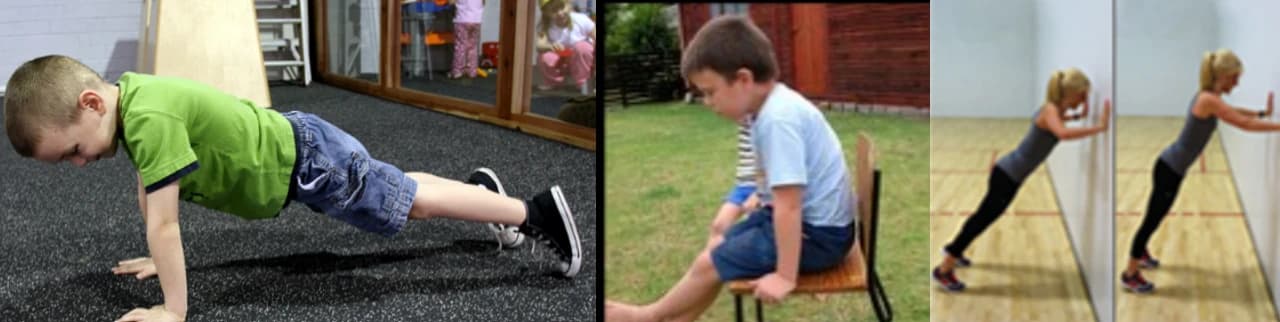
- Push-ups against a wall, floor or chair.
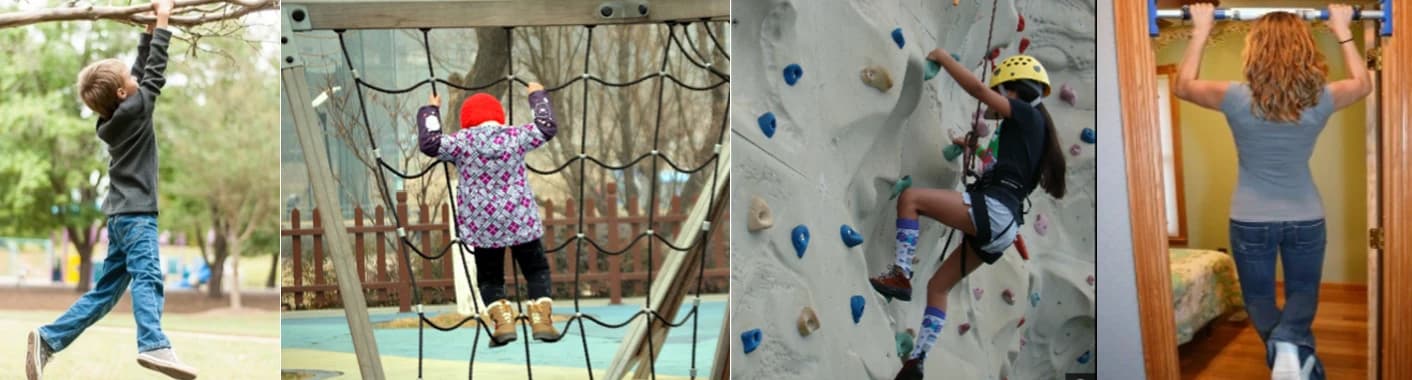
- Hanging and climbing are great proprioceptive activities!
- Some children love being in a body sock. These are made of a Lycra material so children can push against them and get proprioceptive feedback from their whole body. As the material blocks out the majority of visual stimuli (can still see through the material), some children find these really calming.
Sandwich/Squishing Activities
- Make a child "sandwich" between floor pillows or cushions.
- Roll the child up in a mat or a heavy blanket as a "hot dog".
- Give the child heavy blankets, weighted blankets, or sleeping bags (for children) at bedtime.
- Bear hugs.
- Firm towel dry after baths, wrap up tightly.
- Roll a giant gym/exercise ball on top of them while they lie on the floor.
Other things to try
Some children benefit from wearing weighted equipment. This is because the additional weight helps provide them with additional proprioceptive feedback. It is recommended that weighted blankets be between 8%-10% of the child's total body weight. Please always speak to your occupational therapist before using weighted equipment with a child.
Promoting attention and stopping children from rocking in their chairs.
Before learning activities, select some whole-body proprioceptive activities and some vestibular (movement) activities. This will prepare the brain for having to sit still.
Some children benefit from a "move n sit" cushion. This allows the child to have some movement and proprioception while remaining in their chair. Some children need more movement than provided by the "move n sit" and benefit from sitting on gym balls or gym ball chairs. Both of these allow the child to have a controlled amount of movement while they are learning.
The above chair has a move and sit cushion for vestibular input, and some Thera Band put around the legs of the chair. This is so the child can bang their legs against the Thera Band while they are sitting to get some proprioceptive feedback. Some children also find a lap weight and ankle weights helpful when sitting in a chair. Please always speak with your occupational therapist before using weighted equipment.
By Beth Smart - Specialist Occupational Therapist.
Other Useful Resources
- Video on sensory processing & auditory processing - On the Positive about Down Syndrome (PODS) Facebook group: "An overview about sensory processing and info around sound sensitivity, covering the following topics: The Ear, ENT & DS, Sensory Processing, Auditory Processing and Strategies to help."
- ot4kids - Private online courses for parents and teachers to learn the Sensory and Motor Fundamentals to improve children's pencil control through easy, fun activities. Courses aim to help parents and teachers be clear and confident about where their child needs to start and how to begin developing their pencil control to write. Examples are the 5-part online mini-series informing families about sensory processing, core stability and fine motor skills and treatment activities and the 4-week program where the OT goes through different activities in a progress pathway, with weekly live Q and As to support parents directly and access to a private facebook group for the families on the course to get support, designed for preschoolers and children getting ready for reception.