What to Expect: Early Years
Guidance and information for the early years with Down Syndrome
Community Children's Services - Managing On-Going Health and Development Needs
Early Years SEND Advisory Team
Initial contact is made by the Early Years SEND Advisory Team for all preschool-age children who live in Barnet within 3 weeks from referral, within school term time, and may be longer in holiday periods.
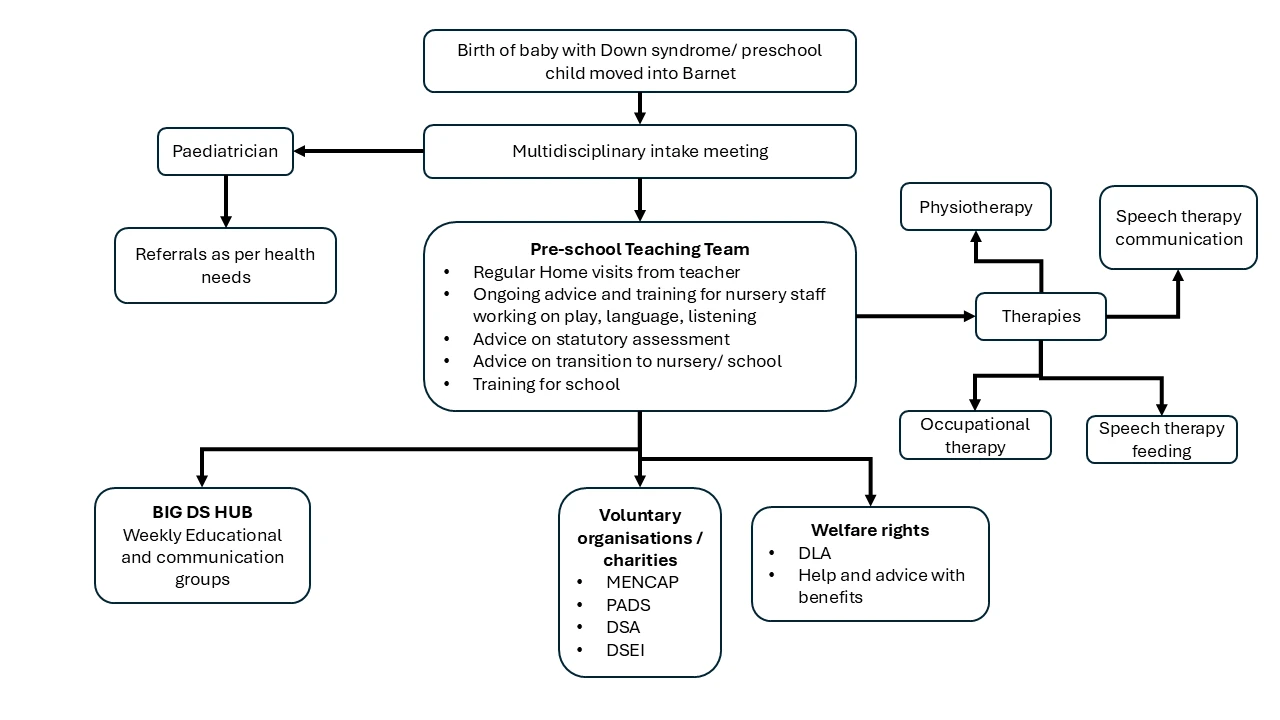
The Early Years SEND Advisory Team provides regular contact for families and visits regularly in the early weeks and months. They are a point of contact for ongoing support and help you liaise with other professionals. Sometimes in the early weeks, it can be very overwhelming, and there are numerous medical appointments. However, as the appointments lessen and things settle, the community team will continue to support you and encourage you to meet other families, particularly through our local Down Syndrome hub at Underhill Children's Centre.
What to expect from the Early Years SEND Advisory Team:
- A comprehensive assessment of need.
- Discussion and information on local services.
- Support and review at key transition stages if required.
- Liaison and referral to other services as needed:
- Children Centre 0-19 support.
- Barnet Mencap.
- Family health visitor.
- GP.
- Community paediatricians.
- Health Visiting and School Nursing (for child transitioning to school).
- Speech and Language Therapy.
- Physiotherapy and Occupational Therapy.
- Community Paediatrics.
- Nutrition & Dietetics.
- Provide families with the new parent pack from Down's Syndrome Association: You and your baby - Down's Syndrome Association.
- Ensure families have this Down Syndrome combined care pathway and have received the Down Syndrome insert for the red book.
- Information and invitation to the DS Hub (the BIG-DS Barnet Integrated Group for Down Syndrome). The DS hub gives families opportunities to meet up and supports their child's developmental needs with early intervention. Families can see a variety of professionals there, who work closely with the Early Years Advisory Team at the hub, e.g. paediatricians, speech therapists and feeding specialists, dentists, physiotherapists and more. The Early Years SEND Advisory Team will give families information about this and together work out when best to access these groups. These groups are held every Wednesday (term time) at Underhill Children's Centre (Mays Lane, London EN5 2LZ. Tel: 0208 349 2423).
- Signposting to additional support services as required, e.g.:
- Down's Heart Group - Children facing congenital heart surgery.
- Information Sheets - Down's Heart Group.
- Benefits advice:
The Early Years SEND Advisory Team will continue to work with families until the child has successfully transitioned into school.
If an older child is referred in, i.e. school-aged and moved from abroad or moved into Barnet, they will not see the Early Years SEND Advisory Team but will have input from community paediatricians and the school nurses, school-based SENCo's and therapists.
Contact Information
Barnet Early Years SEND Advisory Team:
- Address: Early Years Centre, Oakleigh Road North, London N20 0DH.
- Tel: 020 8261 2456 ext 1.
- Email: admin@eysend.barnetmail.net.
- Website: Barnet Early Years SEND Advisory Team.
Early Years SEND Advisory Team Resources
Children's Integrated Therapy (CIT) Services
Physiotherapy, Occupational therapy, Speech and Language therapy and Paediatric Dysphagia teams are all based together and contact information here:
- Address: Whittington Health NHS Trust, 3rd Floor, Westgate House, Edgware Community Hospital, Burnt Oak Broadway, HA8 0AD.
- Tel: 020 3316 8900.
- Email: whh-tr.barnetcit@nhs.net.
Children's Integrated Care Liaison Officer
- Email: whh-tr.barnetCIT.ciclo@nhs.net.
- Referral information and forms (See Barnet Child Development Team Referral).
Accessing the Services and Referral Forms
All the therapies (physiotherapy, SLT, OT and the dysphagia team) form the Barnet Children's Integrated Therapies.
Community Paediatrics
(See Down Syndrome Checklists according to age).
Community paediatricians routinely review children at the following time intervals:
- Yearly after this until transition to adult services, which takes place once a child has left full-time education. See the 3 and 4 year reviews on Preschool.
Additionally, from 14, they also have annual enhanced reviews with their GP.
The hospital paediatrician will also review, as planned, within 3 months at Barnet Hospital, children's outpatients.
Routine reviews can be more frequent if needed.
Contact Details
- Address: Child Health HQ, 3rd Floor, Westgate House, Edgware Community Hospital (EGH), Burnt Oak Broadway, Edgware HA8 OAD.
- Tel: 020 7794 0500, followed by extension:
- Deputy office manager and medical secretary: x26457 or x26382.
- Audiology secretary and appointments: x82398 (DD: 020 3758 2398).
- Clinic coordinator: x82420 (DD: 020 3758 2420).
- Office manager: x26217.
- Medical and SEN secretary: x26272.
Generic Review (at Every Review)
Appointments take place at Edgware Community Hospital or at Underhill Children's Centre (BIG-DS). Initial appointments are 90 minutes, and follow-ups are 45 minutes. See Making Visits to Hospitals Easier.
For each appointment, ensure that the following takes place:
Notes review
- Review of the hospital notes and any discharge summaries.
- Look for any interim admissions to the hospital - Enquire specifically about infections. (See Immune System and Infections).
- Any concerns regarding hearing and vision as identified by the neonatal team, parents or educational setting (See Paediatric Dietetic Service and Top Tips for Triaging and Treating Kids With DS).
- Collate information from tertiary centres / GOSH.
- Organise a renal ultrasound on every baby (unless already under urology/referred previously).
History and discussion
- Enquire specifically regarding medical problems known to be associated with Down Syndrome and take every opportunity to remind families and carers of "red flag" symptoms.
- Perform a full feeding history and assess for risk of aspiration, GORD, and treat according to NICE or local policy guidelines. Ask specifically for coughing after feeds, choking or wheezing episodes (see Dysphagia, Speech and Language Therapy (SLT) for Red Flags).
- Screen for signs and symptoms of Diabetes (See Diabetes and Down Syndrome). Children with Down Syndrome are four times more likely to develop diabetes than other children, so about 1 child in 60 with Down Syndrome will also develop diabetes. It has been reported that, as a group, children with Down Syndrome tend to develop diabetes earlier than other children in the general population.
- Developmental progress.
- Check sleep patterns, including any signs of sleep disordered breathing (See Sleep & Sleep Disorders). Any red flags for sleep apnoea, such as snoring, sweating, gasping, excessive restlessness, mouth-breathing, and daytime somnolence. A video of them sleeping and the noise/sounds associated is very useful, which can be at naptime or nighttime.
- Signs of constipation or other bowel problems. See Constipation to evaluate further - history, examination, triggers, management and treatment, use Bristol Stool Chart to help. Gastrointestinal problems in children with Down Syndrome.
- Ask about family and social history and support network.
- Take time to listen to any parental concerns and watch any videos they have recorded on personal devices that have been concerning them, including sleep concerns or unusual movements.
- Encourage families to attend our DS hub in Underhill Children's Centre. There are weekly early intervention groups led by the Early Years SEND Advisory Team, multidisciplinary input from other allied health care professionals (physiotherapy, Occupational therapy (OT), dentists, etc) and the opportunity to meet other families.
- At each clinic attendance, ensure parents are aware of the "red flags" for cervical spine instability, and that they should seek immediate medical help if they are present (DSMIG guidelines, Atlanto-Axial Instability).
- Remind families and GPs of the importance of aggressively treating sepsis. Where sepsis is suspected, they need to be seen immediately and treated with appropriate antibiotics. Doses may need to be increased or prolonged; discussion with the hospital-based paediatricians on call is recommended. If recurring infections occur, consider antibiotic prophylaxis in discussion with a respiratory paediatrician and seek to find an underlying cause. (See Immune System and Infections).
- Promote the flu vaccine and immunisation schedule (See Immunisations and Vaccines):
- Annual influenza vaccine via GP/practice nurse (from 6 months to 2 years, this is the inactivated injected form, after 2 years it is the nasal flu vaccine).
- Pneumococcal vaccines - an additional pneumococcal immunisation is now universally agreed (from Autumn 2019 onwards) for every child with Down Syndrome and not only those at "high-risk", via a GP/practice nurse.
- From age 2 years - Offer a one-off single dose of Pneumovax II (PPV 23).
Examination
- Plot growth & OFC:
- On the Down Syndrome Growth Chart in notes and in the Red Book (PHCR). (See Growth Charts and Inserts for Red Book) Rapid weight gain (from 1 year) should prompt a check of Thyroid function.
- Developmental Assessment/milestones:
- Griffiths developmental check or SOGS (Schedule of Growing Skills) - highlights can be found in the PCHR (Personal Child Health Record, also known as the Red Book with the extra green insert for DS).
- Social communication skills.
- Cardiovascular examination:
- Rarely, echocardiography, particularly in the first few days after birth, may fail to diagnose AVSD and other major shunt lesions. Hence, there should be a low threshold for repeating this investigation if symptoms or signs of cardiac disease are detected at any age, even in the presence of a "normal" early echocardiogram.
- Respiratory examination:
- Aspiration, viral-induced wheeze.
- Skin:
- Looking in particular for signs of thrombocytopenia.
- Neurological:
- Look for any signs of cervical spine instability or cord compression.
- Lower limb alignment and foot position when weight-bearing, e.g. standing, walking.
- ENT:
- Signs of middle ear disease or upper airway obstruction.
- Eyes:
- Squint, cataract, nystagmus or blepharitis. Nasolacrimal duct obstruction sometimes needs referral.
- Dentition.
- Urology:
- Check for undescended testes at first review at 3 months and every review thereafter - advise parents for an annual birthday check for undescended testes.
3 Month Review (in Addition to the Generic Review)
Notes review
- Cardiology - Initial echo findings and ensuring appropriate follow-up is in place.
- Collate information from the physiotherapist and dysphagia team initial assessment reports, and from the Early Years SEND Advisory Team.
- Ensure all required professionals are involved, including physiotherapist, Early Years SEND Advisory Team, SLT, Health visitors, and hospital paediatrician.
- Ensure there are no missed or outstanding appointments from hospital discharge.
- Hospital paediatrician - Discuss with the hospital-based team - Do they still need to see the family, or can they cancel their appointment with all future medical care coordinated by the community paediatrician?
History and discussion
- Are there any unusual movements or spasms? (Consider Reflux and consider infantile spasms/West syndrome and refer for an EEG (See Neurophysiology Referral Form (EEG) and Melatonin Guidance (EEG Usage)) +/- referral to a consultant paediatrician with a neurology interest at Barnet Hospital).
- Discuss infant feeding and recommend upright feeding to reduce ear inflammation/otitis media and gastro-oesophageal reflux disease (GORD). Explore thoughts around weaning.
- Careful counselling with explanation of the condition, including genetics of the condition and associated medical conditions.
- Enquire as to how the family have adjusted to the diagnosis and offer support as required.
- Make sure a red book insert has been given to parents.
- Signpost again to local resources and contact details of Down's Syndrome Association, if not already known.
- Discuss Disability Living Allowance (DLA and Carer's allowance. This is often more successful when applied for at 6 months of age, but it is good to start the process, as it is rather lengthy. Early Years SEND Advisory Team, MENCAP and Barnet Carers are all able to help with this (See Resources for Families and Professionals).
- Social support services - Consider referral to Social Care/ 0-25 Disabled Children's Team (Referral form - 0-25 Children's Disability Team, Children's Social Care) for early support/universal services assessment. The Multi-agency safeguarding hub (MASH) looks at referrals and can decide which services are most useful for the family. This may be for support for families, therapeutic work around bonding and relationships, support for siblings, a family support worker, help with benefits, housing, social concerns, later on for clubs and activities, short breaks, respite and so on.
- Encourage parents to take videos of any behaviour or concerns they have.
- Start early discussion around weaning onto solids (usually from 6 months of age) in liaison with the paediatrician/feeding team/SLT +/- dietician. Usually guided by these professionals as to when to start and how to progress with textures. It may be delayed if concerns around aspiration and food may need thickening. If the baby was born prematurely, ensure professionals are aware so they can advise accordingly.
- Makaton signing for babies - EY SEND Advisory team have qualified Makaton trainers deliver this free course each term. This course is designed for parents and family members who would like to learn more about Makaton Signing for Babies and how it can help support language development. It runs for 6 hours over 4 weeks. If you would like to be invited, please let your child's Early Years SEND Advisor know, and you will be invited when the next course is run. The course is delivered via Zoom. More information.
Examination
- Eyes - Check for cataracts - Check red reflexes and document, fixing and following and visual behaviour, check for squint and for nystagmus.
- Investigations:
- Check the results of chromosomal testing.
- Check the results of TSH on the Guthrie card.
- FBC and blood film - Has this all been checked and managed accordingly by the hospital paediatric team?
- Does it need discussing with the haematologist? (See Haematology Guidance).
- Check that the Neonatal Hearing test has taken place and act upon any results that require follow-up.
- Ensure cardiology assessment is completed - Every baby needs a minimum of one echocardiogram by the paediatric cardiologist in the hospital.
- Check for undescended testes at 3 months and every review thereafter - Advise parents for an annual birthday check for undescended testes (as even surgically corrected testis can later become undescended and are at greater risk of tumours).
6 Month Review (in Addition to the Generic Review)
History and discussion
- Discussion around weaning onto solids in liaison with the paediatrician/feeding team/SLT +/- dietician. Usually guided by these professionals as to when to start and how to progress with textures. It may be delayed if concerns around aspiration and food may need thickening. If the baby was born prematurely, ensure professionals are aware so they can advise accordingly.
- Report back thyroid results (See Thyroid Guidance for advice).
- Dental hygiene and tooth brushing.
- Therapy and educational input - e.g. Makaton signing through The Early Years SEND Down syndrome advisor or local signing groups.
- Discuss sleep hygiene and routine, daytime naps, night-time wakenings and sleep onset difficulties? For ongoing sleep issues and sleep onset or overnight wakenings - consider if this could be medically related, eg GORD, aspiration, OSA, SDB +/- behavioural component.
- Are there any unusual movements or spasms? (Consider Reflux and consider infantile spasms/West syndrome and refer for an EEG (See Neurophysiology Referral Form (EEG) and Melatonin Guidance (EEG Usage)) +/- referral to a consultant paediatrician with a neurology interest at Barnet Hospital).
- Ensure renal ultrasound been done and results checked. If not, book one.
1 and 2 Year Reviews (in Addition to the Generic Review)
History and discussion
- Have a low threshold for investigation of coeliac disease - See Coeliac Disease Screening. Any constipation? Pain? Fluctuating bowel habit? Concerns around weight?
- Triggers for constipation - Consider pain (e.g. a fissure), fever/dehydration, dietary intake (in terms of fibre content), other medicines, other conditions and family history of constipation. Psychological issues and expression of distress? Toilet training/aversion? (See Constipation for treatment).
- Behaviour and social communication.
- DLA and other benefits.
- Dental hygiene and tooth brushing.
- Therapy and educational input - E.g. Makaton signing through the Early Years SEND Down syndrome advisor or local signing groups.
- Down Syndrome advisor leads on discussions and timings of nursery provision, EHCP planning and also about special educational needs inclusion funding (SENIF).
- Discuss sleep hygiene and routine, daytime naps, night-time wakenings and sleep onset difficulties? For ongoing sleep issues and sleep onset or overnight wakenings - consider if this could be medically related, eg GORD, aspiration, OSA, SDB +/- behavioural component.
Ensure you have checked the following
- The child is not having excessive sleep in the day (catching up on poor nighttime sleep quality) or not enough naps or naps that are too late in the day, interfering with bedtime.
- There are no clear environmental causes for night wakenings (like loud noise or light).
- No behavioural causes/sleep associations are affecting the child from learning to self-soothe (such as rocking the child to sleep or allowing the child to fall asleep on the breast or bottle). Eg. The child learns to expect the rocking to get to sleep, so wakes up and cries as they do not know how to self-soothe and rely on the rocking to get back to sleep.
Some sleep problems can be improved with good sleep habits (sometimes called sleep hygiene).
These are some general strategies that may improve the person's chances of a good night's sleep:
- A nightly consistent routine at bedtime.
- A bedroom that is free of distractions (eg cut out any unwanted light or noise).
- Regular sleeping hours.
- Regular exercise and activities.
- Avoidance of caffeine and other stimulants in the evening.
- Some people have been helped to sleep by a soundtrack of calming sounds.
- A sleep diary can be helpful, too.
For children specifically:
- Watch for daytime naps - Is this age appropriate? Timings? Are they interfering with nighttime sleep? Remember to check car journeys or nursery/school transport - is the child nodding off?
- Look up how much sleep is needed (it is a range) for the child's age and how long it is recommended for the child to stay awake before going down for a nap (if still having naps). Use this knowledge to plan the daytime routine into chunks of time.
- Use this knowledge to help learn and look for sleep cues.
- Encourage the child to fall asleep on their own when DROWSY but not actually asleep, so they learn to self-soothe themselves.
Further support and resources:
- Discuss with the health visitor, who has an important role here and expertise.
- Consider referral to the sleep service at GOSH or Evelina hospital (See Sleep & Sleep Disorders), or trial of melatonin if it is predominantly sleep-onset difficulties (See Sleep & Sleep Disorders for melatonin information).